Promoting awareness of the archaeology and history of north Devon


HOME

CONTACT

MEMBERSHIP

NEWSLETTERS

DIARY DATES

LINKS

TRAINING DAYS

LIBRARY


ACTIVITIES

WEST YEO

Fish Weirs

Hartland

History Days

Holworthy

Parracombe

Sherracombe Ford

Six Acre Farm

Archaeology Projects (external)

Community Landscapes Project

The Exmoor Iron Project

XArch Project


MEMBERS INTERESTS

EDITORIALS


Newsletter Editorial Topics: 2002; 2003; 2004; 2005; 2006; 2007; 2008 ; 2009

Autumn 2002: Chairman's Report.

This is a very exciting time to be involved in archaeology in the northern Devon and Exmoor region. The recent discoveries of Romano-British industrial activity on the west Exmoor fringe promise to cast an entirely new light on the early history and development of this area. In this context, landscape projects such as those developed by the Community Landscapes Project and our own work at Parracombe have the potential to contribute significantly. The point of such exercises is to unpick the layers of landscape development to which, at more than one stage, the mining, processing and transport of metals
must have contributed.

It seems, in fact, that ancient metal-working is becoming the leitmotif of archaeology in North Devon. In summer 2001, members were involved in Dr Gill Juleff’s excavations at Brayford, where evidence of iron-smelting in the Romano-British period is abundant. This year, members were again involved as volunteers on an adjacent site, this time helping out with a District Council and English Heritage funded dig conducted by SouthWest Archaeology on what appears to be an ore-preparation and/or smelting site. Members of NDAS also joined as volunteers in a University of Exeter dig at Sherracombe Ford, where again very extensive Iron-Age and Romano-British industrial activity is in evidence.

Furthermore, during the spring and summer, Trevor Dunkerley, our very active member from Combe Martin was busy again. Not only did he dig another test-pit in his own garden but, with the kind permission of Dr Margaret Eames, he went across to her garden and dug an even deeper one!. Trevor’s work is carried out meticulously, and he manages to extract a lot of significant information from these necessarily restricted excavations. Finds of the waste products of silver-lead smelting in association with early medieval pottery are beginning to suggest that the history of silver mining in Combe Martin has earlier origins than has been thought hitherto. A Tarka Millennium Award will now
enable Trevor to pursue his research by surveying the lanes on the east side of Combe Martin, which look suspiciously as if they reflect early open-cast workings.

The Society’s own projects, the Parracombe Survey and the Fishweirs Survey made progress during the year. Taking advantage of very low tides in the spring, members met three times to comb the foreshore on both sides of the Taw estuary looking for the remains of fishweirs. The main aim was to confirm the presence of weirs recorded on the Denham chart of 1832. Several were found; others have completely vanished. The huge Horsey Weir to the east of Crow Point, which was so prominent two years ago, has almost disappeared under sand. The Parracombe Survey has been focused this year on Holworthy Farm. During one week of July, members of the Society dug on the remaining earthworks of what has been assumed to be a classic hillslope enclosure within Holworthy Farm. The work took the form of an evaluation with a preliminary geophysical survey and the opening of three trenches, principally to assess the state of preservation of the monument and to recover any datable evidence. Unfortunately this was sorely lacking! (We did discover, however, that sheep have a taste for 30 metre tapes!) We must thank Phil and Julie Rawle for their co-operation in allowing us access to their land.

Progress with publication of the Barnstaple excavations of the 1970’s and 80’s is slow. Richard Coleman-Smith, who had proposed to guide the work to publication, has had to withdraw due to ill health. The excavations resulted in the recovery of a very large amount of evidence for the development of the North Devon potteries, and not only here, but in the United States, archaeologists are eager to see it published. The overall aim is to produce a three volume publication at a suggested cost of £200,000. English Heritage has agreed to fund a feasibility study, but until there is a project design in place, no further funding will be discussed. An important contribution to the project is Alison Grant’s revision and expansion of her book “North Devon Pottery - the Seventeenth Century” which will provide documentary background to the archaeology. NDDC is committed to the project and the full support of NDAS has been offered.

Since the Spring, Jo Andrews, who produced the first three issues of the new-look newsletter, has resigned from the position of editor, as her time is about to be taken up domestically. On members’ behalf, I should like to thank Jo for getting the new newsletter launched and to wish her and Clive well for their future. The task of putting the newsletter together now falls to the publications committee, and we are extremely grateful to Bruce Aiken of Aiken Graphics for offering his services in preparing the text for printing. Bruce was responsible for the design and production of the new-style membership card, which I’m sure you will have admired.We must thank him for that too.

Finally, the informal meetings on the first Tuesday of each month at the Chichester Arms, Bishops Tawton have now become a regular feature of life for NDAS members. These are an opportunity for free-ranging discussion in a friendly atmosphere. If you haven’t yet made it to the pub, give it a try.
Terry Green.

2003 Editorial: NDAS and the ‘Big Picture’

With contributions from groups and individuals variously working within the sphere of archaeology and the Historic Environment in Northern Devon, this eclectic edition appears at a juncture where bodies such as Exmoor National Park and Devon County Council are reviewing their strategy for the historic environment. In this process of review we have been asked to make a contribution in the form of comments or suggestions, which is both encouraging and a cue to think about the role and purpose of the North Devon Archaeological Society.

When I first took an interest in the activities of NDAS, the northern parts of Devon represented a puzzling gap on distribution maps and had a low profile in the literature. This was not for lack of archaeology. Frances Griffith’s aerial coverage of the whole county showed that prehistoric sites were abundant in the area; while long-standing studies such as those of Hoskins and Finberg and more recently Harold Fox indicated that there was an intriguing story of medieval settlement to be traced in the landscape. Literature was not entirely lacking. There was Grinsell’s Archaeology of Exmoor and there was Susan Pearce’s The Kingdom of Dumnonia plus her interesting study of churches in the North Devon landscape. When the Historical Atlas of the South-West appeared in 1999, it was refreshing to find detailed distribution maps and some novel studies embracing northern Devon. Then, of course, there was the long awaited and very welcome publication of The Field Archaeology of Exmoor (English Heritage).

Now things have moved on in the field too. The recent discovery of Romano-British iron- working sites at Brayford and Sherracombe Ford is symbolic of that change, but is by no means the whole story. The Exmoor iron-working project is the result of a co-operation between the Exmoor National Park Authority and the University of Exeter. It belongs within a context of new research prompted by both bodies and for which the English Heritage publication The Field Archaeology of Exmoor provides a base-line. This, in turn, belongs in the context of the University’s Greater Exmoor Project which pushes the area of research out well beyond the National Park boundaries. At the same time, a joint effort by the County Council and the University (with the support of the Heritage Lottery Fund) has produced the Community Landscapes Project, which deliberately looks away from from the classic moorland areas and directs attention towards the relatively neglected, but very important surrounding ‘lowland’. Currently the CLP is concentrating its efforts on the Hartland area.

It will be evident from this emerging structure that the focus is on broadly based landscape projects which embrace evidence ranging from the detailed examination of peat cores to the consideration of whole field and settlement systems. For the statutory bodies, ‘Historic Environment’ has become the watch-word and the term serves well enough to embrace the purposes of archaeologists at large. Against this background, local archaeological societies have a newly meaningful role to play. Primarily the special contribution of local societies is that they contain people who know their locality intimately, are dedicated and are in a position to make day-by-day, season-by-season observations not readily available to those working at a ‘higher’ level. Organised together to conduct long-term projects such as our Parracombe Project or our recording of fish-weirs as well as Winkleigh’s ‘House Detectives’ project, local groups are in a position to provide a level of research which represents detailed groundwork and which ultimately adds up to the ‘big picture’. It is a strength of NDAS that we are both able to reach out to a growing number of interested local people and have a good proportion of members with archaeological qualifications who form the bridge between the Society and the academic community.We are in a very favourable position to fulfil the Society’s Aims and Objectives:

By pursuing these objectives through focused projects we are helping to expand the data-base for future research and to secure the protection of the historic environment. Terry Green
Nothing gets done without people doing it!
Field work volunteers are needed.
See the Volunteer Form included with this edition.

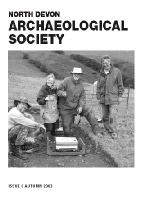
Autumn 2003 A season of fruitful fieldwork; Editorial

This edition carries all together six reports of fieldwork, a matter for celebration after so many years
in which very little field-work was done in northern Devon. This year NDAS members have had the opportunity to participate in excavations both on Exmoor and on Dartmoor, to take part in survey at Hartland, Parracombe and in the Taw- Torridge estuary, to help out with a rescue excavation at Kentisbury and to join in the ongoing exploration of Combe Martin. The opportunity to do hands-on archaeology is to a high degree the result of the good relationships that the Society has with the Exmoor National Park Authority and the University of Exeter as well as the Museum Service and the Sites and
Monuments Register. The ability of nonprofessionals to be actively involved in archaeological projects is variable across the UK. In some areas the degree of non-professional participation is very high and we do not yet approach it, but having started from a low base a few years ago, we can feel pleased with our progress.

Inevitably, since it represents a major and largely untouched archaeological resource, Exmoor is the focus of current work. It can be argued that, like Dartmoor and Bodmin Moor, this preserved upland environment does not necessarily represent the archaeological character of the adjacent lowland, but our understanding has to start where the opportunities present themselves. At the same time, the Community Landscapes Project, which deliberately looks away from the moors towards the lowlands, offers excellent opportunities for hands-on experience.

The CLP’s current attention to Hartland and their invitation to people in northern Devon to become involved ought to be seen as an opportunity for people who find Exmoor a bit remote. The invitation is there to be taken up.

The Exmoor Iron Project excavation at Sherracombe Ford produced further evidence of the extent of Romano-British iron-smelting activity in this area of West Exmoor, catching the attention of the media and for once receiving reasonably accurate coverage. In this edition we have a digger’s eye view of the excavation from two of our members. The Exmoor Iron Project will now turn its attention elsewhere, but from the point of view of North Devon, the earlier work at Brayvale - both the Exeter University excavation of 2001 and the DCC/South West Archaeology excavation of 2002 - together with the findings at Sherracombe Ford add up to a profound adjustment in our view of the later prehistoric and
early medieval background to settlement and resource exploitation in our area. It is to be hoped that artificial boundaries do not obscure the emerging picture.

Whether upland or lowland, whether within or without the National Park, the aim should always be to integrate information. An integrated picture is the ultimate archaeological product. Beyond this however, a very real and important product is a raised level of awareness in the community at large of the value of our Historic Environment and an understanding for its evolution. The work put into National Archaeology Day (July 19th) by Jim Knights and Trevor Dunkerley was nothing less than admirable. Both deserve congratulation. Both the Roman Day at Brayford and the Archaeology Weekend at Combe Martin secured a very high level of community interest and participation and were an example of how archaeological investigation can turn into public education and enjoyment without being relayed through television. The profile of archaeology in North Devon was raised where it matters: in the local
community. And it must be said that this is something we can all do in however modest a fashion. Members of NDAS are made aware by these newsletters of the work that is currently in hand.We hope they are passed around and that other people are encouraged to join the Society. This is a small contribution that everyone can make, a contribution without which the results of excavation and survey would be in danger of remaining in a small number of hands and adding nothing to public understanding.
Terry Green

2004 Working Together - Editorial

‘Networking’ has become a buzz-word, but like most of such jargon, the word meant something in the first place and as far as NDAS is concerned, it neatly summarises what the Society has been trying to do over the past few years. For a variety of reasons there are now throughout northern Devon active archaeological and historical groups.

Against this background of increasing activity, NDAS has been instrumental in bringing people together to share ideas, discoveries and experiences. The recent change to the Society’s constitution formalises the ‘association’ arrangement, whereby groups who so wish have representation on the NDAS committee. In this common forum they can meet on a regular basis, make joint arrangements or co-ordinate their plans, exchange information and jointly make decisions advancing the cause of the “heritage” of the region. This process is still evolving, but we see concrete results in, for example, the cooperation currently being worked out between the Hatherleigh Landscape Group and NDAS. It would be arrogant to claim that this makes NDAS an ‘umbrella’ group. But it does mean that people who are interested in the archaeology of northern Devon have access both to a “neighbourhood” group and to one with a broader, area-wide remit.

Over and above this, of course, there is the Devon Archaeological Society with its long history, its county-wide brief and a national reputation. Perhaps we have inserted an extra tier into the arrangements, which, in such a large and diverse county, must be a good thing.

What about the historical element in this scenario? Increasingly the word ‘historic’ appears as an all-embracing term, as in ‘Historic Environment Record’ (HER) which we used to know as the Sites and Monuments Register (SMR); and a crop of ‘Historic Environment Research Strategies’ (HERS). Somewhat with this in mind, in the past few months the Society has conducted a debate with itself on whether to add the word ‘Historical’ to its name.We are not alone in debating this sort of thing. The Council for British Archaeology’s winter general meeting was devoted to the topic “Bridging the Divides: Archaeology and History in a Common Future”. It is therefore a question which is being examined nationally. After discussion, it was decided within the NDAS general committee and at the Society’s AGM that there was no virtue for us in making a change at this time. It was felt that to extend the Society’s remit in this way would diminish its focus at a time when we are active and effective in what we do.

Nevertheless, since archaeology has to do with the physical remains of the past right up to yesterday, documented ‘history’ provides much of the context.We cannot avoid the fact that archaeology and history flow into each other. There must therefore be advantage in getting together with historians once in a while. There is no single, regional historical society in northern Devon, but there are numerous small groups and individuals beavering away. If we’re not going to expand our brief, why don’t we, therefore, extend our ‘networking’ function and bring these groups and the various archaeological groups together?

With this in mind, the Society is planning a local history forum in the autumn. To organise it, we hope to form a committee with representatives of local historical and archaeological groups from across northern Devon. The aim will be to display to each other and to the general public the work and research in which local groups are engaged. It is not yet certain whether the ‘forum’ will take the form of an exhibition or a day of short presentations or both. Whichever form it takes, we - NDAS and local archaeological groups - will be there beside the local historians displaying a shared interest in filling out the historic and prehistoric picture of northern Devon.

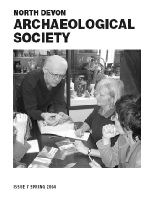
Advancing the good work! Editorial Autumn 2004

First an apology for the late appearance of this newsletter. One reason is legitimate; the other is just excuses! You don’t want to hear excuses, so here’s the perfectly good reason. It seemed sensible to wait until we could report on the Local History Day that NDAS organised at South Molton on 23rd October, which is what we did, but then other things intervened and …
Anyway, here it is at last.

The History Day was a great success and achieved its objective, namely a gathering together of people in northern Devon who have local history on their minds. It was about sharing and networking, and, as somebody said around lunch-time on the day, it’s actually happening! Now of course, the thing is not just to leave it there. The central register of groups and their interests which was proposed at the end of the day should be a starting point encouraging people to share information and get together productively. An initial product of this might be a public exhibition, which might be followed - who knows – by further exercises in making knowledge widely available; publications even?

Networking certainly worked for the Holworthy dig. It was very well supported not only by NDAS members, but by our neighbours from TAG (Tiverton) and by people who are not in any group, but had heard about it through the media. Holworthy takes up a large part of this issue of the newsletter for the very good reason that it is important in regional terms and a significant NDAS achievement. Hillslope enclosures have been high on the agenda of archaeology in the South-West for a very long time, yet apart from an example at Rudge near Morchard Bishop (excavated by Malcolm Todd in 1986-9), none in Devon has hitherto been looked at in any detail. The Holworthy hillslope enclosure becomes only the second in the county to reveal its nature and it’s been a bit of a surprise. These things are usually supposed to be late prehistoric (Iron Age) in origin, but Holworthy appears to be much earlier and (barring any surprises when we get a Carbon 14 date) is stretching the chronology and is currently the only proven Bronze Age settlement on Exmoor.

Mention of C14 dates prompts me to point out that excavation and particularly postexcavation costs money. While we have been fortunate in raising grants to help out, in the end we have to rely on our own resources, ie. the membership subscriptions. Hence we are currently having a membership drive with a new publicity leaflet being placed in libraries, museums, tourist information centres and even in estate agents’ offices. You will have received an example with this newsletter which we should like you to place under the nose of someone who might be persuaded to join. If your local library or museum does not appear to have any, please let us know and we shall resupply them (or you can collect some yourself from the Museum of Barnstaple and North Devon).

From all this it should be clear that NDAS is making progress in raising its profile, reaching out and achieving its aims. None of this happens without people making an effort. It was terrific having so many volunteers helping on the Holworthy dig, but we still have a limited number of individuals tackling the organisational tasks. Let’s be quite frank about it here. The Society needs more members to come forward and help – we need fresh blood. If you feel that you could help in any way, from organising an open day to just making the tea - or perhaps helping to produce this newsletter (?), please make yourself known to any committee member. Your society needs you!

2005 Editorial Spring

Since the last newsletter in autumn 2004 we have had an AGM at which certain changes to the committee took place. Three members stood down and four new members were elected. Among those standing down was Rosemary Akers who has been involved with NDAS, and before that with the old Barnstaple and North Devon Rescue Archaeology Committee, for some 30 years. This makes Rosemary’s association with North Devon’s archaeology almost as old as the Society itself which will soon be coming up for a 40th birthday.

Elsewhere in this edition Maureen Wood has written out some reminiscences of working side by side with Rosemary over the years and we thank Maureen for her contribution. Here I would just like to say that the Society is extremely grateful to Rosemary for her years of support and active involvement in saving and interpreting the remains of North Devon’s past. The continuity that she and others from the ‘early days’ provide for us late-comers is a great asset, and I’m sure readers of the newsletter would value more reminiscences from long-standing members. Perhaps something for the next edition?

At the other end of the spectrum, as it were, we have some fresh blood on the Committee representing the influx of new members that the Society has seen recently. David Parker (who incidentally dug years ago on the Paiges Lane excavation) has proved himself invaluable, devising a flotation tank and taking charge of the bulk samples from Holworthy; Mary Houldsworth, having set out to get herself an A-Level qualification, has become very involved with survey at Parracombe; Marion Hughes has been a regular attender at the ‘pub’ meetings and is happy to take on social functions; and Malcolm Faulkner, as a very interested farmer, provides a link with the farming community. They will all, I am sure, make a valuable contribution to the running of the Society. Alistair Miller has stood down from the Committee and has been replaced as Secretary by Derry Bryant. The Society is grateful to Alistair for his work as Secretary.

The other significant outcome of the AGM was an increased membership subscription. The figures set out in the annual report, which you will all have received, made clear the reason for a need to increase the subscription and the rise from £12 to £16 was unanimously agreed upon at the AGM. Here I should just like to expand on what the subscription represents. Apart from covering the costs of running the Society, hiring speakers and a venue, producing the newsletter, providing insurance for the Society’s activities, it ought also to be seen as representing your wish to make the aims of the Society achievable.

As set out in the Society’s constitution, these aims are:
• To promote awareness and interest in archaeology and history with particular reference to northern Devon.

• To encourage field survey, recording and research.

• To promote the preservation and interpretation of ancient monuments and antiquities in the region.

• Where appropriate and necessary, to excavate to professional standards and to publish the results of research.

This is a pretty broad brief and any one of its elements is almost infinitely extendable. A mark of our success in achieving these aims, however, must be the increasing range of individual research activity and growing knowledge that is apparent among members. In addition the networking with local groups that was promoted by last year’s Local History Day and the links which the Society enjoys with bodies such as Exmoor National Park and North Devon AONB are an indication of the calibre of the Society’s members and their efforts. Above all the Society needs to be able to support and encourage ongoing and innovative archaeological/historical research activity in the north of Devon: this is what the subscription is about.

In this edition we have highlighted, as standard fare now, the further progress of the Society’s excavation at Holworthy Farm and the sterling work that Trevor Dunkerley has done and continues to do at Combe Martin. In addition, however, we have contributions from new members who are either pursuing their own objectives or making an original and uniquely useful contribution to furthering the Society’s projects. What has not been featured, but is worth mentioning here, is that the fish-weirs project that we began some five years ago, has been brought nearly to completion by Chris Preece who is planning to publish the results in the county journal, the Proceedings of the Devon Archaeological Society. Chris has shown considerable tenacity in bringing this project to a conclusion, especially as the field-work depends entirely on infrequent favourably low tides in the Taw-Torridge Estuary and on having sufficient volunteers to help out. One of these favourable tides will be on 21st August. Please try to give Chris a hand, if you possibly can.

Autumn 2005 How well are we doing?

Let us consider the stated objectives of the Society. These were quoted at you in the last editorial (Spring 2005), so please excuse the repetition. Our aims are:
To promote awareness and interest in archaeology and history with particular reference to northern
Devon.
To encourage field survey, recording and research. To promote the preservation and interpretation of ancient monuments and antiquities in the region.
Where appropriate and necessary, to excavate to professional standards and to publish the results of research.
How far are we achieving these objectives?

In early October we had another Local History Day. In terms of objective number one, this event was a success, but could be made even more successful in future by strong promotion through the media.Our programme of winter talks is also open to the public at large, and we get a number of visitors on most occasions, so there too we are fulfilling our aim. Although there are bodies such as the National Park, the National Trust and the recently formed AONB organisation whose job it is to inform the public about the sites of which they have charge, there is probably more that we could do to ensure that people are informed about the historic sites in their neighbourhead. On the other hand, when we have an energetic soul such as Trevor Dunkerley setting up a website to publicise the archaeology and history of North Devon, it is clear that there are new and innovative ways of promoting awareness.

“Field survey, recording and research” is well represented by the fishweir survey which is now complete and, in the hands of Chris Preece, is approaching publication. Survey is the mainstay of many an archaeological society, for the very good reason that it represents non-intrusive data gathering on which further work can be based. It takes many forms: recording of standing buildings, the recording of field-boundaries, field-walking, map work, documentary research, and, if you have the equipment (as we do), geophysical survey of known or suspected sites. Survey is, above all, something in which all members can participate. It is essential groundwork which may represent an end in itself or the basis of further, more specialised investigation. How good are we at it?

Well, the fishweir survey represents successful completion, while the conduct of geophysical survey is on the rising side of the learning curve; there is still work to do on the field-boundary survey at Parracombe and the survey of standing buildings has hardly got off the ground.

As for promoting the preservation and interpretation of ancient monuments and antiquities in the region, we have made representations to NDDC on heritage aspects of the Local Plan and have had some success in getting it adjusted. Interpretation takes us back to “promoting awareness”, and there is more we could do to see that local people and visitors are provided with information.

Finally there is excavation which comes at the end of the list. The vast majority of the general public would probably put it first, since the idea of archaeologists as primarily diggers is fostered in literature and the media. Most professional archaeologists will tell you however, that excavation, being basically destructive, is a last resort. In the case of Holworthy Farm, excavation has come about as part of the “Parracombe Project”, but primarily because hillslope enclosures have been crying out for investigation,
there being no other way of getting to grips with their function and chronology, and we were in a position to take it on.We have worked to professional standards with thorough preparation, clearly stated objectives, financial arrangements in place, full recording, commissioning of specialist reports and a plan for publication.We are committed to this standard wherever we have occasion to excavate.

In considering our successes and our shortcomings, it is important to remember that we are a voluntary organisation and that we do what we can. Nevertheless, we have already set a standard which we hope to maintain. The various contributors to this edition of the newsletter have each in their own way fulfilled one or more of the Society’s objectives. They are the strength of the Society, and as our membership steadily increases, we would hope and expect to achieve more and to consolidate our position in this part of Devon.

2006 Editorial Limitations and possibilities

During the last six years or so archaeological activity and research in northern Devon have stepped up considerably and we pride ourselves on being involved in these developments.We have an increasing number of members who are probing the archaeological potential of their area and contributing to a detailed appreciation of the history of northern Devon. This is very encouraging and all to the good. However, this increased level of activity has now highlighted the need to set out guidelines so that the results of individual researches are found to be useful and valid and so that members do not come into conflict with other people who have a stake in the land and the archaeological resource.

The NDAS Training Day held in February and conducted by Sean Hawken (now appointed Project Manager of Xarch) was concerned with the processes and requirements of setting up a local project. During the day Sean gave examples of community-based projects and detailed the steps that have to be taken to get a project - especially a fieldwork project - off the ground.

These included acquiring all the necessary permissions for access to sites, doing the preparatory research, arranging finance, working out a project design and, most importantly, deciding how results are to be made accessible to others. A very good example of the process in action has been the survey of Holwell Castle, Parracombe, conducted by Mary Houldsworth and Jim Knights: they started with consent from the landowner, from Exmoor National Park and from English Heritage (because the site is a scheduled ancient monument) and ended with a very workmanlike report, copies of which have gone to all the interested parties.

Of course, not all local researches by individuals end up as full-scale fieldwork projects. You may simply be curious about humps and bumps in a field or may have noticed a scatter of pottery or flints or you may have become aware of a development that affects a historic building and feel you should look into it. Since almost everything that may come to your attention will be on private land, there is the immediate question of avoiding trespass. Therefore, before embarking on any intrusive activity, your first duty is to contact the landowner or his or her agent and get permission. This is where your NDAS membership card comes in: the card is your bona fides, your credentials assuring the landowner that you have a legitimate interest and are approaching him or her in good faith. If you wish to look any more deeply into what you have noted, you should make the Society aware of what you are doing, so that you are covered by your NDAS insurance against personal injury and public liability and so that you have the Society’s support. In addition you should alert the County Archaeological Service to what you have found so that it goes onto the Historic Environment Record (HER). See also Fieldwork

Over and beyond these really quite basic conditions, there is the question of what kind of project a local “amateur” society can legitimately pursue.We exist in a situation that involves archaeologists with several different hats. There are the academics, the local government professionals, the commercial archaeological contractors and the voluntary independents or “amateurs”. Archaeology in Britain began with the amateurs, mostly vicars and landed gentry and retired army officers, and for a long time there was not even an academic discipline devoted to the topic; and even when it did develop it continued to be identified with the upper classes.

By a long evolutionary process, mostly through the second half of the 20th century, we have come to the present situation where the four strands identified here ought to be complementary to each other. Our contribution is to provide local detail. If we have done our work well enough our results should feed through to the academic quarter where they gain significance on a broad canvas of theories of the past. At the same time, by the very nature of its membership, the local group has the ability to demonstrate the meaning and value of the local heritage to the community who are mostly eager to know. Increased knowledge leads to deeper appreciation and is ultimately a guard against environmental degradation.

So what do we do?

Unlike 30 years ago, amateur groups are generally excluded from taking on “rescue” or any work where planning is involved: there are indemnity issues which place this beyond the amateurs’ reach. On the other hand, it is perfectly legitimate to raise the alarm when something is threatened.We do however, undertake research, which can embrace basic reading around the subject, documentary research, survey, recording, digging and finally publication.We have the luxury of pursuing our interest without being constrained by the need to make it pay and without being harried by developers or planners. Above all, we are on the spot and through knowledge and a love of the locality are as well placed as anyone to make discoveries and to be alert to the significance of local features. Providing we understand our limits and respect the restraints outlined above, maintaining good relationships with landowners, etc., we can build projects on our interests and contribute to a growing understanding of the past much in the spirit of the indefatigable 19th century gentlemen who started it all.

2007 - Editorial Shrinkage and Growth

If you study the section headed ‘Officers of the Society’, you will notice that our once populous committee has suffered some attrition. The reasons are various – including, very sadly, the death of one long-standing member – but the development has been worrying since the Society is supposed to represent the interests of a large number of people spread across the whole of northern Devon. In these circumstances it is important to have a strong committee to present a range of viewpoints and to take well debated decisions. The existing committee has therefore taken the step of co-opting four NDAS members to join their deliberations for the remainder of this year (ie. up to the AGM in April) in order to maintain comprehensive representation. Not having been put to the vote at an AGM, these individuals may be regarded, under clause 4d of the NDAS constitution, as associates invited to serve on the committee. The Society will be invited to vote on their full membership of the committee at the AGM.

The NDAS Committee has invited James Coulter, Stephen Hobbs, Margaret Reed and Judy Parker to join them. James Coulter and Margaret Reed are both well known local historians. James has taken on some of the task of producing the newsletter and Margaret has devoted time to pursuing documentary sources for the Parracombe Project. Stephen Hobbs is a dedicated Hartland historian and archaeologist and Judy Parker has been admirably energetic in publicising the Society’s existence and activities throughout the area.

The addition of ‘historians’ to the committee as opposed to ‘archaeologists’ makes the point, which has been raised before in this newsletter, that the division between history and archaeology is old-fashioned and outdated; it also begins to address the odd fact that, although many local communities have their historical societies, there is no overarching historical society for northern Devon, and just as oddly, there is none for Barnstaple or Bideford or Ilfracombe. If you look on the website of the Devon History Society you will find that they list local history groups in the county, but none is north of Chulmleigh or Wembury. The focus is mainly on Exeter, South Devon and Dartmoor, another symptom of the usual Devon divide between north and south.

We know however, from the experience of the Local History Days that we held in 2004 and 2005 that there are numerous groups in the northern Devon area beavering away and who would be glad to have a forum where they could exchange ideas and information. It might be objected that there is no virtue in perpetuating a division between north and south in the county, that there already exist county-wide societies to which people are able to subscribe. However, we are most of us aware that north and south Devon have a different culture and demography and that therefore interests differ. NDAS has done a good job over the last five or six years of bringing together people from across northern Devon who share an interest in the region’s archaeology. Why not do the same for history? In fact, as has already been said, history and archaeology are fully complementary, so we have no option but to head in this direction.

As to publicity, Judy Parker has done a first class job of pointing out to people in the area that we are here and active. She has put on a roving display of the Society’s activities in various libraries and has missed no opportunity to distribute our leaflets to anyone who will take them; this has resulted in a crop of new members and we are grateful to Judy for her efforts. Partly as a result of our raised profile, the Council for British Archaeology (CBA) South-West Division has asked us if we will host the CBA South-West Annual General Meeting in North Devon in April 2007. This is quite a feather in our cap and of course we are very happy to do so.

Finally, XArch, the Community Archaeology Project based at Exeter University, has already proved its worth in our area. Projects at Hartland and at Brayford and our own project at Six Acre Farm have benefited from the technological input that XArch is able to make available. As has been emphasised before, the aim of this project is to involve local people in their own “backyard” archaeology and to provide financial and technical support so that local projects can develop along lines which produce sound results while encouraging a sense of local ownership. Xarch is in the position of providing a conduit between local knowledge and interest and the academic world where detail is added to and may alter the fabric of the broad brush picture of the past that academics construct. Xarch continues to merit our support.

2007 - Keeping a Good Thing Going

We try to make this newsletter a combination of news about what's been going on and what is planned together with snippets of interesting information and updates on the progress of projects. It can only include what is known to the compilers and what we manage to extract from people we approach. As you can see, the coverage stretches right across the north of Devon from Hartland to Lynton and down to Hatherleigh. This is the kind of sub-regional coverage which was always our goal. Nevertheless, there must be a great deal that is being missed. If you know of activities that ought to be included, or have queries or observations that you would like to have aired, please feel free to communicate them
to the editor (see Useful Information).

In a sense the term 'newsletter' no longer describes this publication. The last edition was described by one NDAS member as somewhat like 'Devon and Cornwall Notes and Queries', in that it brings together both items of actual news and pieces of information that are of local archaeological/historical interest. It has certainly evolved from the days when the newsletter was a couple of photocopied sheets. It has become - or is becoming - an organ through which members (and some non-members) can report on their active projects or research, raise issues and share information, raising the profile of what goes on in the north of Devon. At the CBA AGM at Hartland in April we were offering spare copies for sale to visitors and received some very good comments on the quality of production and the range of
articles.

Now in addition we finally have, thanks to Alison Mills and Stephen Hobbs, a website up and running www.ndas.org.uk. At present you will find there extracts from past newsletters (a good opportunity for new members to catch up). Looking at the site, it's quite astonishing to see how much of North Devon's archaeology and history has been covered and cast in digital form in the last few years. As this site develops it represents a permanent opportunity for members to post their researches, interests and questions in a form which is accessible worldwide. Link this to the new website that Trevor Dunkerley is planning for the Combe Martin Silver Mines Research and Preservation Society (CMSRPS), and you will have Internet access to most of the activities of local societies in northern Devon.

None of this, of course, comes about by itself.
People put it in place. During the last year a small editorial committee was formed to produce the newsletter. Unfortunately one of the members is heading abroad and the others are busy people (hence the late appearance of this edition). So offers of assistance are very, very welcome. We already have a good thing going, but ambition doesn't have to to stop here. Local researchers are doing valuable work which ought to reach a wide audience of interested people. On the other hand, possibilities are limited by the time and expertise that are available from volunteers. Without sufficient volunteer assistance, the project may collapse. If you are able to help (with contributions, with useful contacts, with proof reading, with editing, with simply filling envelopes), then please let us hear from you.
Contact any of the Committee (See 'Useful Contacts') any time.

2008
Progress and Problems
The most exciting work that NDAS members are currently involved with is the survey project at Hartland. Building on the outstanding documentary work done by Stephen Hobbs and the Hartland Society and on the understanding of Hartland's history that this has led to, geophysical survey was begun over a year ago on the coastal area above Hartland Quay and on the area of St Catherine's Tor to the south of the Quay. With the technical support of the Exeter University XArch Project (successor to the Community Landscapes Project) the survey is producing quite astonishing results which point to the existence of a complex prehistoric landscape in this exposed coastal area. In addition, landscape survey inland is adding to the understanding of the medieval landscape; and, with the permission of the landowner. Sir Hugh Stucley, there are plans afoot to survey the grounds of Hartland Abbey. This is all good stuff and it has been agreed that the work at Hartland shall be treated as a joint NDAS/Hartland Society project. At the same time, at the other end of our area, we go on nibbling away at Parracombe, where Margaret Reed has done excellent documentary work and where we hope to do further survey work at West Middleton.

Another very positive development is that the NDAS website is now up and running. If you key www.ndas.org.uk into a search engine you will find articles from all of the Society's past newsletters brought together thematically. This is a great boon to new members and provides anyone with an interest in the archaeology of northern Devon with an overview of the Society's activities. Here too we have to thank Stephen Hobbs for taking the website in hand and finally achieving what we had long hoped for. And in terms of promoting the Society, Judy Parker too deserves our gratitude for the hard work she has put into publicising the Society's activities and programme.

Now the difficult bit. We are about to lose not only our secretary but also our treasurer/membership secretary. These have to be replaced. Derry Bryant has been the NDAS Secretary for a number of years now, during which time she has done an outstanding job of recording meetings, conducting correspondence and communicating with members. She has organised the three Local History Days that we have held and she has taken responsibility for applying for an 'Awards for All' grant. She has taken on these tasks willingly and the Society owes her its gratitude. Jane Green has been the Society's Treasurer and Membership Secretary for five years and feels she has done it long enough. She has very efficiently kept the NDAS finances in order and has kept track of the ebb and flow of membership. To Jane too, the Society owes its thanks.

New blood on the Society's Committee is always welcome, and this may be an occasion to take on new talent. The opportunity exists therefore, for any member with appropriate skills and commitment to take on either of these roles which are vital to the Society's functioning. Elsewhere in this newsletter Jane Green decribes the work she has been doing as treasurer/membership secretary, so that any member interested in the job can see what is involved. The workload that Derry Bryant has taken on over and above dealing with minutes and correspondence was of her own choosing; the principal requirement of the Society's secretary is to take and write up the minutes of meetings, to communicate information to Committee members and to deal with correspondence and to be the society's primary contact. Any member who feels he or she could take on either role and help NDAS to continue to function is invited to put him or herself forward.
Please speak to Derry on 01769 572963 or Jane on 01271 374429 or the Chairman, Terry Green also on 01271 374429.

May 2009

1.The 2009 AGM

The annual general meeting 2009 was held at the Castle Centre, Castle Street, Barnstaple and was well attended. A major item on the agenda was a proposed change of the Society’s name to include the word ‘historical’. In the ensuing debate it emerged that such a change was not popular with the attending members, but it was agreed that the Society’s purpose – which inevitably includes historical research - should be expressed in a strap-line added to the NDAS logo. The words are taken from the Society’s founding constitution of 1959.

At the meeting Bob Shrigley was voted Vice-Chairman. All other officers as well as the general committee were reconfirmed in their positions. However, since the meeting, James Coulter has regretfully resigned as Treasurer and Membership Secretary and has left the NDAS Committee. At the committee meeting held on 8th April it was agreed that until such time as a permanent appointment can be made, Margaret Reed would carry out the duties of Treasurer and Membership Secretary. We owe thanks to James Coulter for the efficient way in which he has worked on the Society’s behalf during the last two years.

2. The NDAS Committee

The NDAS Committee consists of subscribing members plus representatives of related and interested bodies. Until recently the membership has been represented by 15 Committee members, but the number is now down to 12. In order to ensure that decisions are taken by a sufficiently representative quorum of members, it is desirable to keep the number up. The Committee needs new members who are dedicated to the Society’s objectives. If you are one of those or you know someone who is, then please propose yourself or get someone to propose you or nominate a member (with their consent) who you think would do a good job. Pass your nominations to Margaret Reed 01271 325276 or email margaret.reed@talktalk.net.

3. Marking the 50th Anniversary

You will notice that your new membership card celebrates the 50th birthday of NDAS which held its first meeting at South Molton in the spring of 1959. We are marking this significant anniversary in two ways.

During the summer we are aiming to publish a small volume of articles on the archaeology and history of North Devon. This is not an academic publication, but a selection of well written and illustrated pieces on a variety of topics ranging from an account of a recently discovered Iron Age settlement near Witheridge to a light-hearted ‘romp’ through 150 years of reporting of archaeology in the North Devon Journal as well as contributions on local historical themes. All paid-up members will receive a free copy, and then it will go on sale to the general public. This will probably be the first such publication dedicated entirely to North Devon.

As the 50th Anniversary of NDAS coincides with the 50th birthday of North Devon AONB we are together organising a day-conference in October. The day, entitled ‘Time and Tide’, will be dedicated to the archaeology and history of the North Devon coast and will be a first for North Devon. The date is Saturday 24th October, the place the Landmark Theatre at Ilfracombe. We have lined up five main speakers who will talk on themes ranging from environmental change in the Bristol Channel to the North Devon Coast in the Second World War. It is hoped that the day will be introduced by Mark Horton (you will have seen him on Coast on TV), who is an AONB ‘Champion’. Priority for bookings will go to NDAS members up to 30th June. It will then be advertised to the general public. See the details and booking slip included with this mailing.

4. Recent Events:

On Sunday 5th April a number of NDAS members turned up at West Yeo Farm near Witheridge at the invitation of the owner Kate Palmer to be introduced to the history and current developments at the farm and to be conducted on a walk around the land by Kate herself. The afternoon finished up with an excellent cream tea in the farmhouse dining-room. West Yeo, earlier known as Fremaniscot and apparently as Ratdon, is probably of pre-Conquest origin. The late medieval house was burnt down in 1870. The present farmhouse is around 130 years old and lies immediately to the north of the earlier site. The farm is run on organic lines with a pedigree herd of Devon red cattle. Kate is carrying out a programme of restoring lost field boundaries and is very interested to learn more of the farm’s history. We can help her with this. See item 5 below.

On Saturday 16th May, 12 members met in the Henry Williamson Room adjacent to the Local Studies Library for a training day. The subject was the use of documentary sources to trace the history and evolution of a place (house, farm, village, parish, etc.). In the first half of the morning Margaret Reed gave an overview of the published and unpublished sources held by the Local Studies Library, the Athenaeum and the Record Offices. This was followed by a Case Study presented by Terry Green, showing how the history behind a barn at Clawton near Holsworthy had been unravelled. In the afternoon members carried out researches of their own; then finally Tim Wormleighton provided a tour of the library and the document stack. The day was enjoyed by all and we owe Tim our thanks for turning up to guide us on his day off.

5. A New Project

Recently Dr Chris Carey from Birmingham University involved children from schools in Braunton as well as volunteers from the village in a geophysical survey of the hilltop enclosure at Knowle. Following the survey, Chris Carey was keen to encourage NDAS members to take on more widespread survey work in the north of the county where there are ‘hundreds’ of sites about which very little is known. If a local society such as ours could develop a programme of integrated surveys it would greatly advance the understanding of North Devon’s archaeology. Derry Bryant, who took part in the survey at Knowle, is keen to set up a pilot project based on West Yeo Farm using the Society’s earth resistance meter. To start the ball rolling Chris has recently provided us with two sessions of tuition in the principles and practice of geophysical survey at Pilton Community College, and it is now intended that we should begin a survey at West Yeo Farm, Witheridge in June. Ideally such a survey would bring together a wide range of resources to clarify and complement the results of geophysical survey. This work has the potential to initiate a long-term programme of survey in the North Devon area. This is something that is needed and requires the active support of NDAS members. Survey at West Yeo will begin in the week beginning 15th June. If you wish to become involved contact Derry Bryant on 01769 572963 or email derrybryant@tiscali.co.uk.

6. Things to do this summer

On the afternoon of Sunday 7th June Stephen Hobbs will be available to guide a party of NDAS members (+ family members) round Hartland Abbey. Stephen is extremely knowledgeable about the Abbey and its history/archaeology and it is a privilege to be guided by him. The cost is £7 per head, a discounted rate for NDAS members ( minimum number in party 10, maximum 20). Stephen would like us to meet at 1.00pm at the Abbey in order to look at external features - the probable location of the remains of the medieval abbey - before visiting the house. After the visit you are able to buy a cream tea, walk around the grounds, stroll down to the coast.
If you wish to be included, please contact Alistair Miller on 01598 740359 (or email alistair@mrmiller.orangehome.co.uk). Pay through Alistair on the day.

Heather Adams, PhD student at Plymouth University needs the help of volunteers with fieldwork that she is conducting this summer on Exmoor, where she is investigating the potential of small valley mires to provide palaeoenvironmental evidence of Exmoor’s past. New volunteers could be involved in identifying and assessing the condition of mire sites, vegetation survey, or coring for palaeoenvironmental samples. No experience is necessary, as all fieldwork will be organised and accompanied, and full training will be given on site. Dates of fieldwork are very flexible, and no long-term commitment is necessary! If you would like to be involved in the project, or would like details of what will be involved in the surveys, please contact Heather Adams by email at heather.adams@plymouth.ac.uk, or by phone on 07736944722.

On Saturday 27th June the Devon History Society is holding its Summer Meeting at Mortehoe. As NDAS is affiliated to the Devon History Society NDAS members are invited to attend the day at a cost of £2.50 per head. The meeting will take place in the Village Hall and will begin at 10.15. During the morning there will be talks on the history of Mortehoe followed by lunch, either bought for £4.00 in the hall or taken at one of the local pubs. During the afternoon there will be a talk on Church and Chapel in Mortehoe Parish with a visit to the church. The day will conclude with a cream tea. For details and to book contact Miss E.H.Maycock, 2 Bicton Place, Exmouth EX8 2SU or phone 01395 272755.

Rolle Canal Society has a programme of summer walks on 21st June (from Torrington Station), 12th July (from Velator Quay), 26th July (Bude Canal Basin) and 23rd August (from Rosemoor Gardens). For details of the programme and for information about the Rolle Canal Society call 01237 473801 or email anthonybar@gmail.com.

18th and 19th July at Arlington Court, as part of National Archaeology Week, you can hear talks on the history of Arlington and join a guided archaeological walk around the grounds In the second half of July there will also be events at the Museum of Barnstaple and North Devon including an exhibition by NDAS.

In addition, Nick Duncan who lives at Taddiport, Torrington is working on the site of a cottage (next door to the reputed site of the leper hospital) that fell down many years ago. He is finding very large quantities of medieval and post-medieval pottery and would welcome help with sorting and cleaning his finds. Any volunteers please phone Terry Green on 01271 374429.

7. Winter programme

Having just got into the better weather, it’s a shame to start thinking about next winter. However, you will need to know that as from October 2009, the NDAS winter talks will no longer take place on Mondays at Pilton, but will take place on Tuesdays at the Castle Centre, Castle Street, Barnstaple. The programme should be with you by September.

8. Membership
Your membership of NDAS is helping to ‘promote awareness of the archaeology and history of North Devon’. If you haven’t already renewed your subscription, may we remind you that annual subscriptions became due on 1st April (single membership £16, couples at same address £24, students and juveniles £5). Subscriptions should be sent to to Margaret Reed, 58 Littabourne, Barnstaple EX31 1PU. Please help the Society to advance the cause by encouraging others to join.


Copyright © 2010 North Devon Archaeological Society